5 Somatic Tools I Actually Use When My Nervous System Feels Overloaded

In This Article:
Why nervous system regulation isn't always about making uncomfortable feelings disappear
How to identify whether you're in a ventral vagal, sympathetic, or dorsal vagal state
The difference between calming down and building capacity
Five simple somatic tools I use to support my nervous system when life feels overwhelming
How to track small nervous system shifts and why those tiny changes matter
What to do if nervous system tools don't seem to help right away
You know when you are overstimulated and then someone asks “what do you want for dinner?” and it just feels like an unreasonable question to ask? Is it just me?
Sometimes nervous system overwhelm can be pretty obvious and sometimes it’s more stealth and sneaks in. It can look like doom scrolling, irritability, inability to focus, exhaustion, and normal tasks feeling unmanageable.
When overstimulation, overwhelm, or just too much is happening the last thing you want to do is make a decision or figure something out.
So, when it comes to nervous system tools, you don’t need complicated, you need simple.
In fact, when it comes to nervous system tools, you don’t need a whole lot. You just need a couple that work for you and it’s even better using two or three, because the body often begins to recognize the pattern and may start settling even before the exercise is complete. A pattern starts to form.
So, pick what works and run with it.
I am going to go over five of my favourite somatic tools that I use. If you want to get right to those, click here.
Otherwise, I want to offer you a little more information so you know how and why to use the tools and are able to track what works.
Before You Start: Check In With Your Nervous System
I want to bring in some learning and awareness when we use these nervous system tools.
When we start to pause for a moment and recognize where our nervous systems are, we can start to bring in a bit of curiousity, a little learning, and more comfort and less resistance, no matter how we feel.
So we pause, we notice the state of our nervous system and then we will check in later and notice any shifts, even if its a tiny little bit. A tiny little bit MATTERS, it’s the beginning of a new pattern.
I really encourage you to notice because the small shifts mark a change and if you can change a little, you can shift a lot.
The goal is curiosity, not forcing a shift or self diagnosing.
Sometimes you may notice the tools help a lot. Sometimes they help a little. Sometimes they don't seem to help at all. All of that information is useful.
So, begin by looking at the three nervous system states below and notice which one you are in and notice the intensity of that state that you’re in. Then you will use a tool, pause and notice how you feel afterwards.
Notice in the diagram where you might be and remember that you can shift between the states throughout the day.
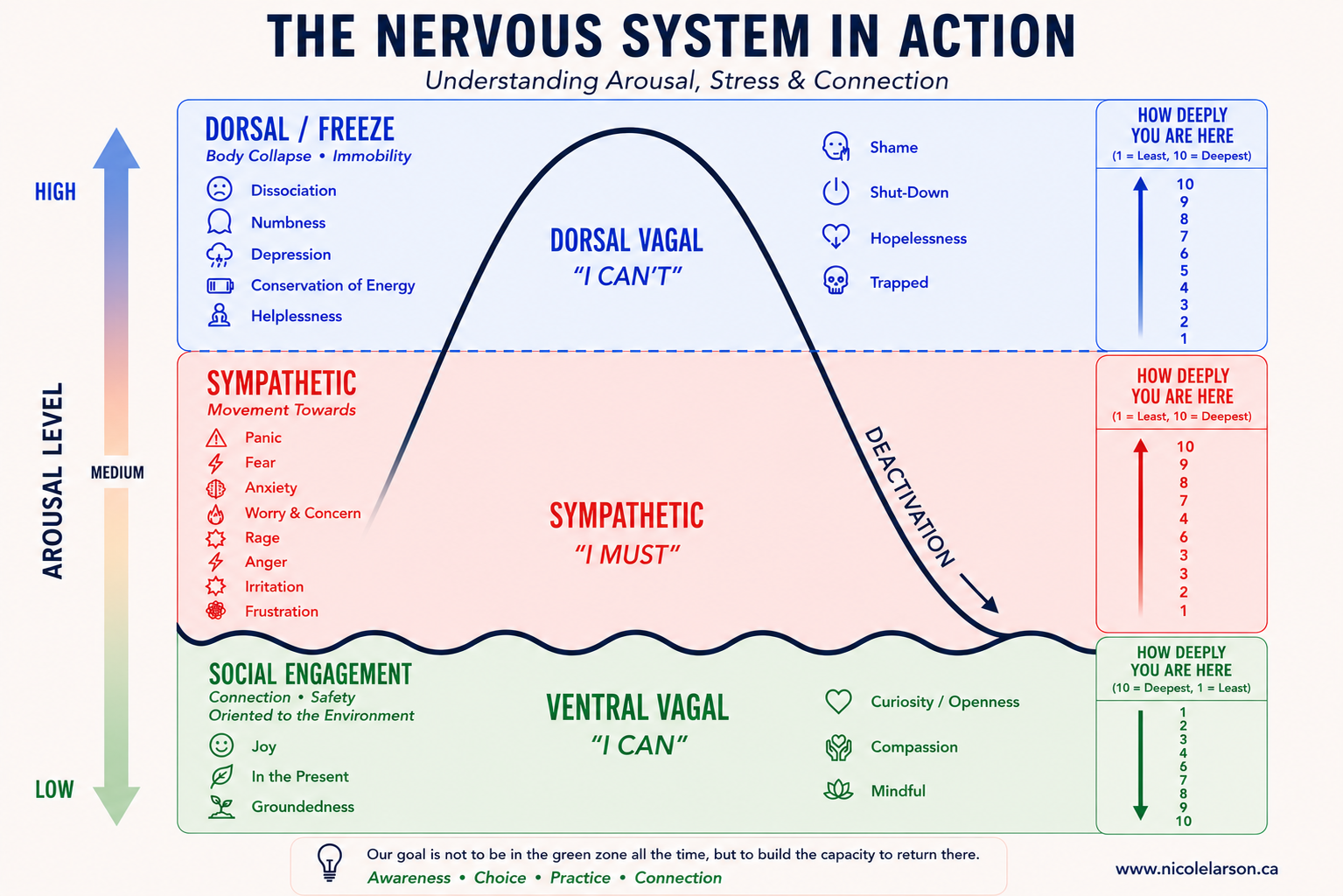
When the nervous system is healthy and regulated, it moves between these states as we need.
Dysregulation happens when we are stuck in a state for too long.
Noticing what state you are in will help build a new relationship and understanding of your body and nervous system and how to support yourself. You'll be able to track how your nervous system responds and shifts overtime.
So notice, what state might you be in?
Maybe anxious and a bit sympathetic? And how intense is it? Is it closer to a one or a 10?
Or are you feeling low energy and flat? Maybe you are in a dorsal or freeze state, again notice the intensity of that state.
Or maybe you are feeling happy, calm, open, and alive. You are more in a ventral vagal state.
No matter what state you're in, your body is always doing its best to protect you, these tools will help bring in more safety and support to your system so it can find it’s way back to feeling safe.
Regulation Isn’t About Being Calm All the Time
When I started using nervous system regulation tools and exercises, I had one very clear agenda in mind:
I want this feeling to stop immediately.
Can you relate?
I mean, fair enough.
And this is where I started and that is great, sometimes we just need a little bit of relief.
But the pro level of this work is learning to use the tool not necessarily to make the feeling disappear… but to help you stay with what you’re experiencing with a little more comfort. And getting here takes time.
We call that building capacity. So when you use these tools, see if you can ask yourself, “What does it feel like to use this tool? Can I feel my body a little more without getting overwhelmed?”
Beginner level:
“How do I stop feeling anxious?”
Intermediate level:
“How do I regulate my nervous system?”
Somatic-Pro level:
“How do I stay connected to and support myself while feeling anxious?”
That shift in relationship to how you feel can really change everything, because resistance and fear in anticipation of uncomfortable feelings can start to dissipate completely.
Nervous system work isn’t always about making sensations disappear. Often it’s about helping the body learn that activation, emotion, stress, or discomfort can be experienced without immediately going into bracing, fear, shutdown, or overwhelm.
We are looking to:
building flexibility
increasing capacity
recover with more ease
feel safer experiencing emotion and activation
And often, regulation looks like returning to settling and feeling calm.
This does take time and if you are in the place of “how do I stop feeling this way?” that is a great and motivating place to begin.
The Somatic Tools
1. Orienting
What it is
Slowly looking around your environment
Letting your eyes land on things that feel neutral, pleasant, or interesting
How to do it
Pause and settle into a chair and/or feel your feet on the ground.
Begin to slowly look around the space that you are in. Experiment with letting your eyes lead your head and neck as you explore color, shape, texture, light, shadow, and objects in your space, as if it’s your first time seeing your space.
See if you can notice how your body reacts as you slowly look around. Does a spontaneous breath come in? Do you feel more settled? Maybe some tension relaxes a little bit.
Experiment with looking all the way behind you and above you. When you're done, pause and notice.
Why it helps
Anxious systems tend to narrow around threat, here you are taking in all of our surroundings and showing through sight that you are safe in the here and now.
Orienting widens awareness (rather than narrows it) and helps bring the body into the present moment
This is an easy exercise that you can do anytime and is especially great when you enter into a new space.
2. Voo Breath
What it is
Gentle extended exhales
Vocalized “voo” sound
Directly stimulates the vagus nerve
How to Do it
Sitting or standing, feel the ground and seat. Let gravity help you drop into what is supporting your body.
Place a hand on your belly if it is comfortable.
Take in a breath and let out the sound “vvvvvvvvooooooooooooooo”. It kind of sounds like a fog horn. Notice where you feel the vibration of the sounds and keep making it until your breath runs out.
Pause. Notice where the vibration was and what you feel now.
Repeat for 2 more times.
Why it helps
Can support down-regulation and stimulate the vagus nerve which helps regulate breath, heart rate, digestion and drives the parasympathetic system or “rest and digest” in the nervous system
This tool is especially great if there is anxiety or nervousness that affects your digestive system.
Extended exhales also signal safety to the body and help it move into a rest and digest state
3. Rocking the feet
What it is
Pressing feet into the floor
Shifting weight back and forth from the heel to the ball of the foot
Stretching out the toes
How to do it
Begin in a chair, this could also be done standing.
Feel your feet touching the ground, notice if you feel more pressure on the left or the right.
Begin to rock the feet back and forth shifting the weight from the front to the back. Do this slowly.
You can also experiment with stretching out the toes almost as if you were trying to press them into imaginary sand and squeeze it towards you.
Why it helps
If you are feeling anxious, angry, or panicked a lot of the pressure and activation moves to the upper body. With this exercise we are bringing movement to the lower body which lowers the intensity of what you are feeling in the upper body.
Can help discharge activation
Helpful when anxiety feels buzzy or overwhelming
This may seem overly simple, but I swear it's somatic magic.
4. Wall Push
What it is
Pushing against the wall when feeling annoyed or angry
Try this when you're feeling angry or when you can't stop thinking about what you wish you said to someone.
How to do it
Begin by standing in front of a wall.
Notice your feet touching the ground and do a slow scan of the body up through the legs, the hips, the torso, the shoulders, the chest, the arms, and the head.
Feel any energy in your body and notice where it is.
Now stay connected to that energy and place the hands on the wall and begin to push.
Relax when you feel that your body wants to stop pushing.
Now this part is important, notice what your body feels like after the push.
If your body wants more, repeat one or two more times.
Why it helps
The nervous system is designed for creating boundaries and defending itself. This helps complete that fight response.
Activation can get “stuck” when we freeze or brace, this helps safely channel it through the body.
Important reminder
It does not need to be intense
Small pushes count
5. Self-Hold
What it is
Holding your arms or shoulders
Wrapping in a blanket
Holding a pillow
How to do it:
Sit in a chair, ideally with a back support. Feel and lean into the support of what is holding and supporting your body.
Take the right hand and place it under the left armpit. Pause. Notice how it feels and how the body responds.
Now take the left hand and wrap it around the upper right shoulder. Pause and notice.
Feel the pressure from the arms and and the back supporting the chair. Notice what it’s like to breathe here.
If it feels good, you could also sway back and forth.
Why it helps
Creates pressure that can stimulate the parasympathetic or “rest and digest” part of the nervous system
Creates a sense of support, containment, and grounding when things feel like too much
A form of self-co-regulation. Notice what it's like to be held by you.
Check In Again
After trying a practice, pause and notice what shifted. This could seem small, or maybe even boring but it's actually where a lot of the nervous system changes integrate.
Notice if maybe:
your breath softened
your shoulders dropped
you feel 5% more settled
your thoughts slowed slightly
nothing changed at all
Nervous system work can be sneaky powerful.
Notice if anything is new over the next couple days as you continue these practices when needed.
And remember those tiny small shifts add up into big changes overtime.
When Regulation Feels Hard
Many people will notice that these tools do help, even if it's just a little bit.
However if you notice that this didn't help immediately, you are not failing. Some nervous systems will need more support through a practitioner, they may need more repetition, or more slowness.
Hear me when I say this:
Healing is less about fixing yourself and more about building the safety, support, and flexibility that you need and then letting what happens happen.
An Invitation
These are my favorite tools that I use and I noticed that they really help support my nervous system and be with whatever I'm feeling with more comfort.
So start off small, pick one to two tools that resonate with you and continue to practice with them and notice what happens over time.
Continue to check in with your nervous system state before and after using nervous system tools.
Every time you practice, you are casting a vote for what you want your nervous system to look like and how you want it to operate in the future.
You have got this. It has been so helpful for me and I've seen it work for many others as well.
If you want more one on one support I would be glad to provide that you canfind out more about that here.
You can also check out my somatic video library here or sign up for my 7 day Somatic course here.
Stay in contact with me through my bi weekly newsletter, which I can promise you is worth reading. You can sign up for that here.